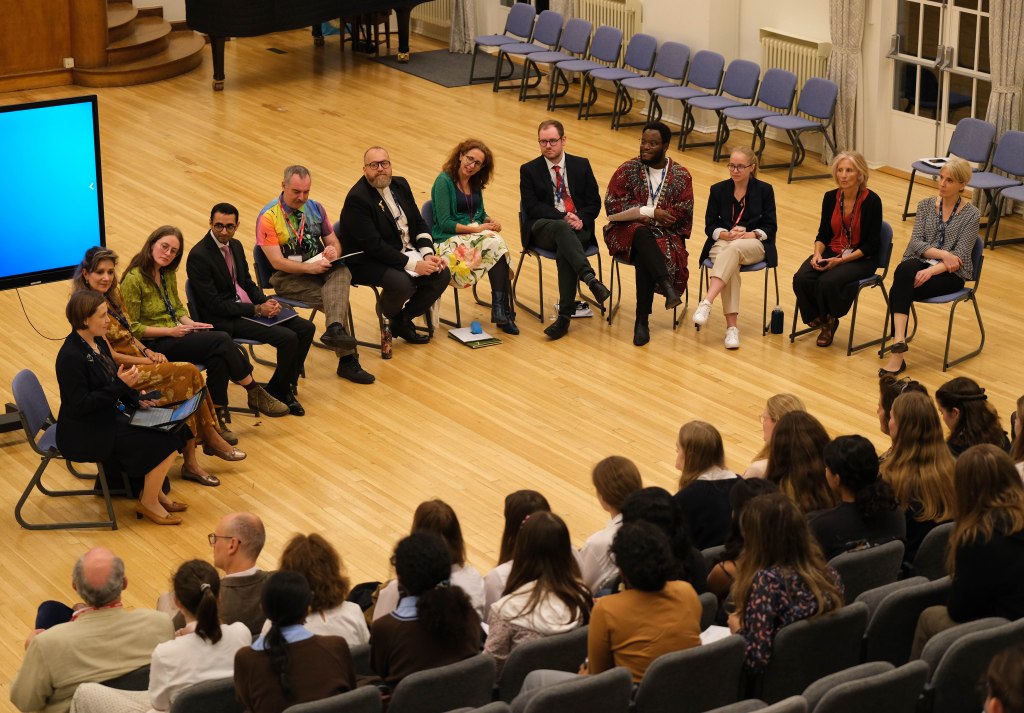
The annual Modern Languages Symposium during MFL Week was an absolute highlight. We were lucky enough to welcome DPhil student Ms Marie Marine from Oxford with her engaging talk on the ‘Mermaid Myths Across Oceans and Eras’ which provided insight into the cultural significance of the figure of the mermaid across the Globe and throughout history. Students were then able to delve deeper into their particular subjects of interest by choosing to attend two talks out of the variety of breakout rooms on offer. The evening closed with a panel discussion across all speakers, tying together the different ideas discussed and nicely rounding off what was a thoroughly enjoyable evening.
Struwwelpeter – the development of children’s comics in the German-speaking world and ‘Das Unheimliche’ in fairy tales

Mr Johnathan Robinson and Frau Pampus
Herr Robinson treated us to an engaging talk on the history of German comics. He explained their development from satirical political sketches, intended for adult audiences, into collections of short stories with pictures now aimed at child audiences and eventually into the classic children’s comics, during the 1850s, which have become beloved staples in modern German culture such as ‘Struwwelpeter’. He also discussed the many similarities between early children comics and fairy tales, highlighting their moral stories and shared aim to teach children a lesson about good and bad. ‘Struwwelpeter’ is one of the better-known German children’s comics from the time and combined both the moral story aspect of children’s stories and a satirical angle, drawing on comics’ origins – political satire sketches. This talk was especially engaging for German students as Herr Robinson delivered his wonderful talk in German – which rather shocked my non-German speaking friend who had decided to come along.
Luckily Frau Pampus’ insightful talk on how fairy tales have stayed ever present in literature was in English. She explored how key themes in fairy tales and folklore such as portraying a distorted reality to tell a story play a key role in the works of Kafka, Hoffman and Heine. She also explored how the ‘uncanny’ or ‘unheimlich’ in German plays a role in fairytales as the heroes are often out of their comfort zone and usual setting.
Alles in allem a very engaging evening.
By Olivia
Tales of Africana: Power and Resurgence in Diaspora Folklore

Mx. Mouelle Makolle
During the MFL Symposium on the 10th October, students were lucky enough to hear a talk from Mx. Mouelle Makolle on the history of folklore in Western Africa. Speaking about the oral culture of storytelling, they referenced specific stories that influenced their childhood such as the stories of Kirikou. Mx. Mouelle went on to talk about the process of colonisation and the influence it had on the folklore of Western Africa.
I was honoured enough to learn about the Yoruba communities and how French and British colonial rule impacted them. With the predominantly written-down stories of the West, the oral stories from Western Africa were often unfortunately lost. This interested me in particular as it is fascinating to see the multiple ways and extents to which the process of colonisation impacted the culture of Western Africa.
Finally, the talk centred on the long-term influence of Black People in France, and the idea of ‘Negritude’. This term is used to describe a literary movement developed mainly in francophone countries. The concept aims to cultivate an idea of ‘Black consciousness’ across the African diaspora and to take pride in the cultural aspects of Afro-Caribbean heritage. A big thank you to Mx. Mouelle for the insightful talk that opened my eyes to an aspect of Afro-French culture that just is not spoken about enough.
By Anya
In search of ‘accessible literature’: Italo Calvino’s ‘Italian Folktales’ and the importance of readability.
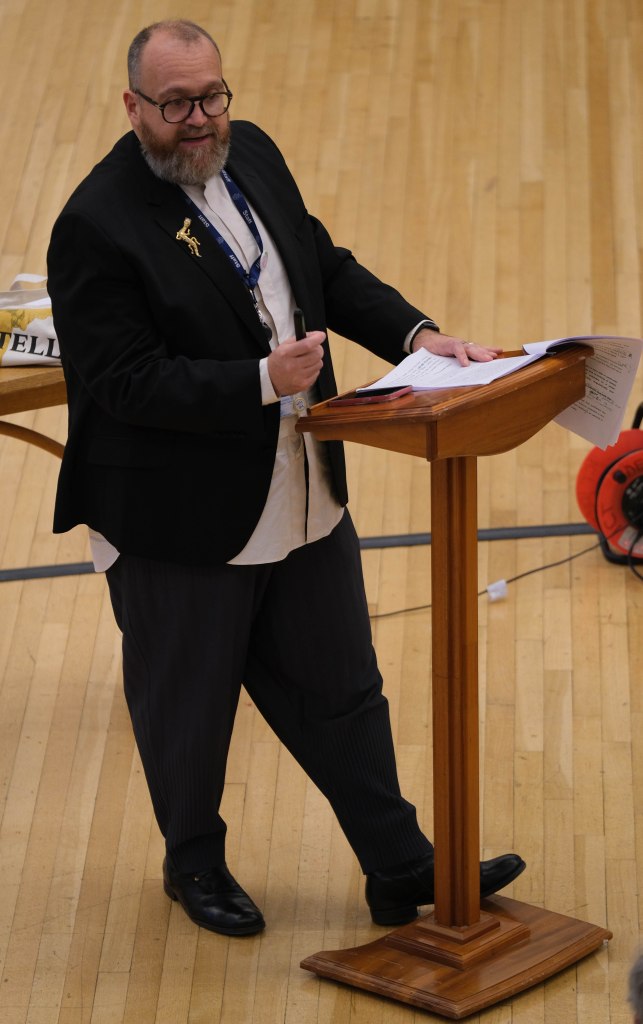
Dr Ibba
Italo Calvino’s ‘Fiabe Italiane’, published in 1956, was a collection of two hundred pre-existing fables from all the regions in Italy which were reworked into, what Calvino hoped to be, a national collection of Italian folktales, providing unity and a collective heritage amongst the nation.
Through doing this, Calvino aimed to make the fables more available for readership by the larger audience of the general public as opposed to just scholars, a radical notion in comparison to the complex reading of the time. Calvino also feared that the gradual decrease of the use of dialect in Italian conversation would in turn lead to the erasure of fairytales and therefore ‘Fiabe Italiane’ marked his attempts to convert oral material into writing in order to preserve the Italian folkloric heritage in danger of being lost.
However, this required great precision and care as Calvino needed to ensure his edited fables were kept in stylistic unity and national dimension while also conserving the regional distinctiveness of each, making sure to not culturally alter them but to
represent each precise community more clearly. Perhaps it was in this sense where Calvino failed, as critics pointed out that since he was not from the south, he could not possibly attempt to successfully capture the cultural nuances and regional significance conveyed through the various regional dialects. Therefore, Calvino’s reworks were very much his own, with the new versions adhering to his own personal taste as a writer. Perhaps his idea would have worked fifty years prior, when Italy was radically changing culturally and politically, however, in the 1950s, dialects needed to be preserved instead of further lost.
Calvino also faced comments referring to his lack of creativity, with many branding him as simply copying other fairytales. However, Calvino believed that the act of narration is indeed a combinatory act – by putting together different stories each with different characters, Calvino believed that he was creating new combinations which in turn created infinite stories. The power of a story actually lies within its infinite variety and repetition which provides the writer with the challenge of opening a path to the hidden text of the story which has not yet been told.
By Anusha
A dive into Chinese Fairy tales and Legends
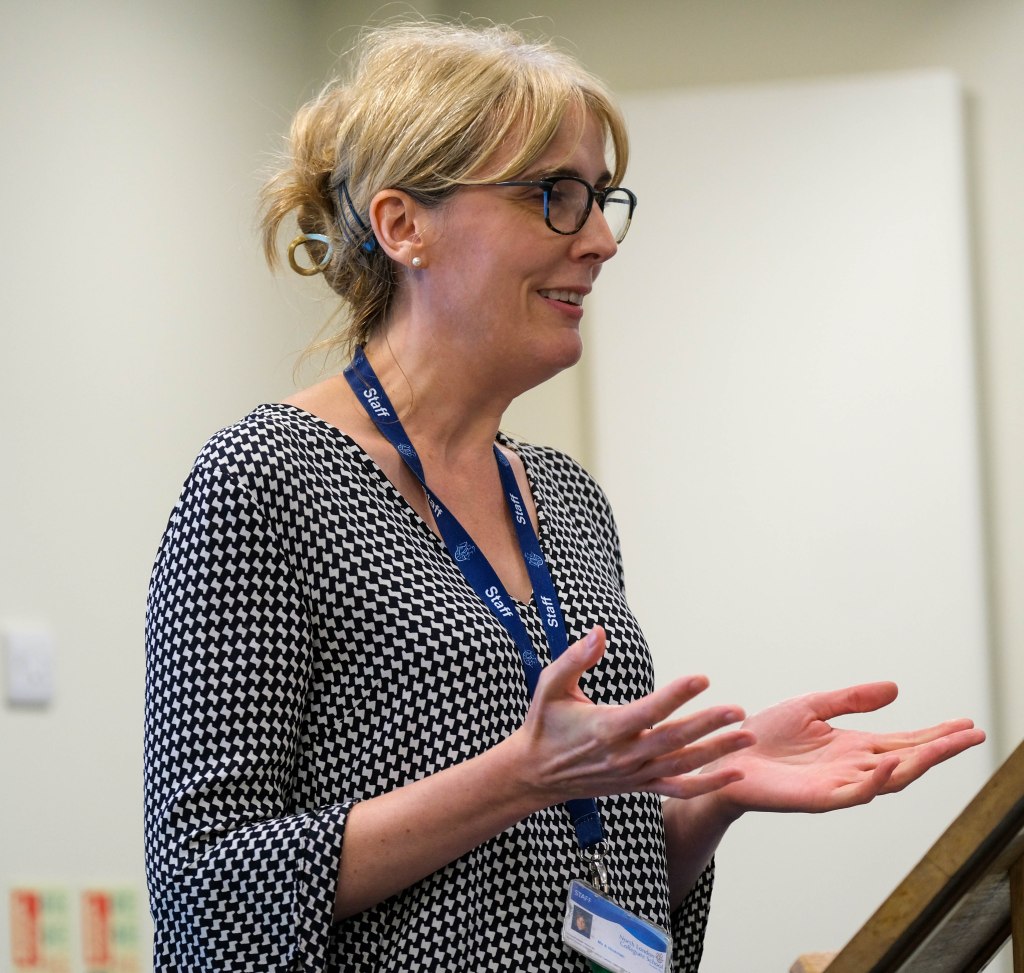
Ms Hickman
During the MFL Symposium on Tuesday, Ms Hickman’s lecture gave an insight into the richness of Chinese folklore. She explored three recurring themes: “filial piety”, “fighting tyranny”, and “feisty females”, with examples ranging from love stories to tales with slightly grimmer themes. Although Chinese tales are many and extremely significant in the culture, even hearing a few stories considerably nurtured my fascination in and appreciation for Chinese folklore. For example, the story of the Butterfly Lovers is often dubbed the Chinese Romeo and Juliet. It involves ‘fighting tyranny’ due to the hardship
of resisting an arranged marriage and has a bittersweet ending as the lovers’ spirits are reincarnated together as butterflies. Contrastingly, the story of ‘The Magic Cask’ exemplifies the importance of 孝 (filial piety): a farmer who discovers a cask that multiplies everything inside it is punished for forcing his weak grandfather to shovel money out of the cask, as he ultimately loses the money and the cask. Overall, the lecture provided an invaluable insight into how these themes permeate Chinese folklore, as well as how themes like filial piety demonstrate Confucian ideas of social harmony and order.
By Sonia
Baba Yaga: Goddess, Crone, or Feminist icon?
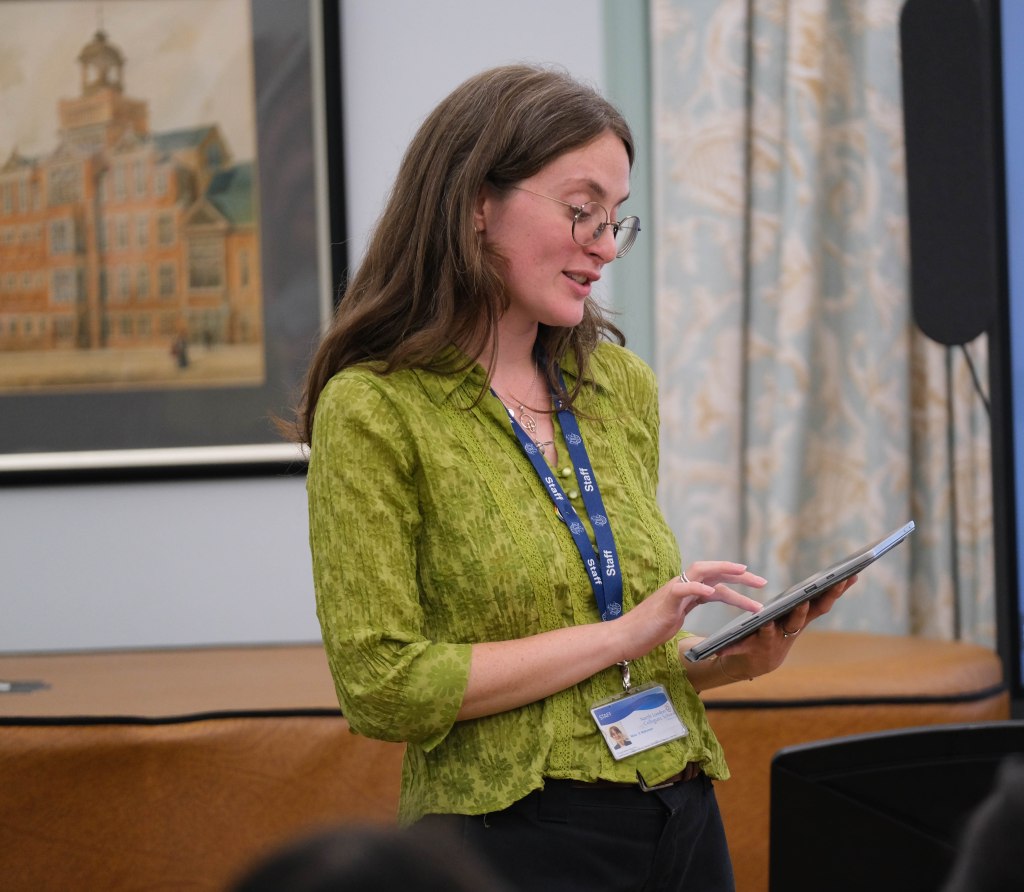
Ms Makower
In her fascinating talk, Ms Makower explored the character of the witch Baba Yaga – a recurring figure in a variety of stories from Eastern Europe. Her character is expressed in different ways – in some stories she appears as a deceiving trickster with bloodthirsty punishments, and in others she offers help to the hero or heroine, like in the story of Vasilia the Beautiful, often appearing as a symbol amongst forest wildlife and magical objects. Although she embodies different forms to serve the intended moral of different stories, Baba Yaga is mostly associated with the classic figure of the ‘old crone’ in Russian fables. However, to some, it might even seem that her characteristics of antisocial behaviour simply represent her unusual personality in comparison to the younger, more graceful female characters. Ms Makower explored how perhaps her character is misunderstood as an evil witch and could instead be seen as embodying independence and female empowerment.
It is tricky to put into words the essence of her character and the sense of the slightly comic evil that she evokes at times because of the number and variety of folktales where she appears. When written down, the charm and slight peculiarity of her character isn’t quite captured in the clever implied ways that are digested differently by everyone when tales are heard orally and passed down through generations.
by Sophia
The Great Fables of the Hispanic World
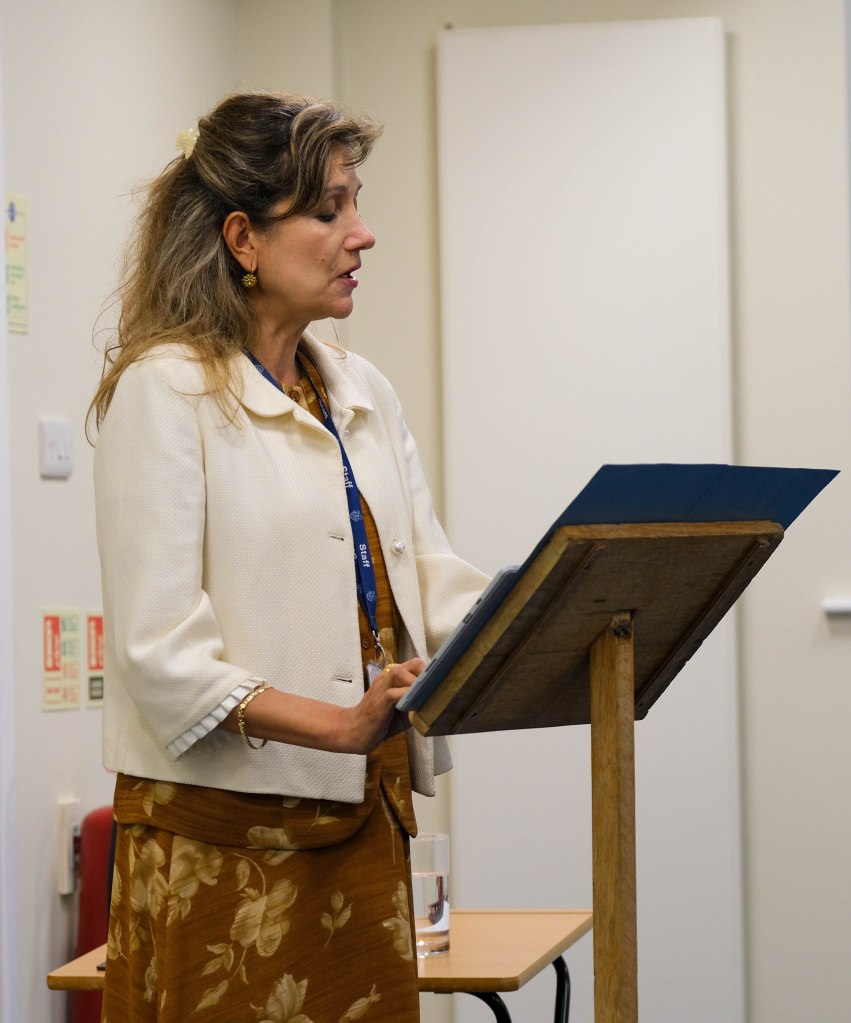
Señora Yerbury
Ms Yerbury kicked off her insightful talk with two of Spain’s most notable fabulists in the 18th century, Iriarte and Samaniego, who competed with their poems. Both were considered revolutionisers of Hispanic fables, however they had different approaches to poetry; while Samaniego focussed on writing fables for children to learn morals such as ‘El leon y el ratón’ (‘The Lion and the Mouse’), Iriarte was interested in the use of language for comedy. One of his famous pieces was ‘El cuervo y el pavo’ (‘The Raven and the Turkey’), in response to criticism he faced. In fact, many Spanish fables served as political weapons, such as Alfonso de Palencia’s ‘Batalla campal entre los perros y los lobos’ (‘Pitched battle between the Dogs and the Wolves’), supposedly a metaphor for the Castilian government. But the importance of fables is not limited to Spain – fabulists have also targeted the political situation in Mexico, with stories about the civil war and revolts. One example is ‘Los animales congregados en Cortes’ (‘The animals gathered in Cortes’) about advocacy for freedom and emancipation. The Nicaraguan government was similarly criticised in Ruben Dario’s ‘Los zopitoles’ (‘The Vultures’). Lighter topics of Hispanic fables include humility, love (like ‘El libro de buen amor’, ‘The Book of Good Love’, by Juan Ruiz) and disobedient children. A famous instance is ‘Rin Rin renacuajo’ (‘Rin Rin the Tadpole’) who leaves his house despite his mother advising against this, and eventually his friends and he are eaten. This story is used in Colombian textbooks, still holding a lot of relevance. A significant use of fables was for native Americans to voice their difficulties. A fable published in 2023, ‘El mensaje de la selva’, discussed the effect of climate change on indigenous tribes. Thank you to Ms Yerbury for her diverse and engaging symposium!
By Aashna
Mr Majithia: Stravinsky’s ‘Rite of Spring’

Mr Majithia’s talk discussed the 1913 riot at the premier of the highly experimental ballet ‘Rite of Spring’, by composer Igor Stravinsky. The ‘Rite of Spring’ is a narrative ballet concerning Russian community enjoying the start of spring. A young girl dances herself to death as part of a ritual. Whether this play is a true representation of Russian paganism. The premiere in Paris on the 29th of May 1913 provoked the audience the point of a riot. This ballet followed the successes of Stravinsky’s ‘Firebird’ (1910) and ‘Petrushka’ (1911) and was controversial for its outspoken portrayal of Russian paganism. Mr Majithia indicated that Stravinsky drafted this ballet uniquely to his prior ones; his notebook presented as a collection of ideas rather than a continuous development of ideas, and the melodies were sketched as if he had heard them before. Though Stravinsky had emigrated out of Russia and distanced himself from his Russian peers, he requested extracts of Russian folk music and it clear through the changes in time signature and keys throughout the ballet that he subconsciously captured the nature of Russian folk music. Mr Majithia also noted that Stravinsky is often solely credited for the creation of ‘Rite of Spring’.
By Zara


 The Linguist NLCS