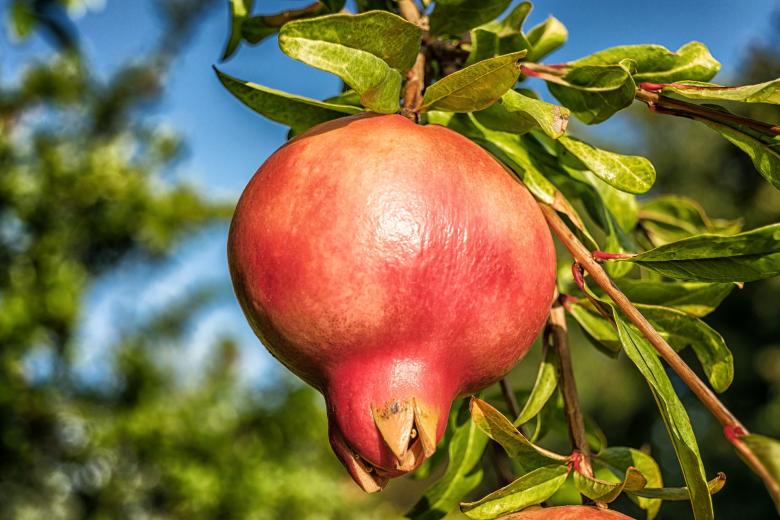
For the Steven Spender competition, Solène (Year 13) translated the poem “¡Granados en cielo azul!” by Juan Ramón Jiménez.
¡Granados en cielo azul!
¡Granados en cielo azul!
¡Calle de los marineros;
qué verdes están tus árboles,
qué alegre tienes el cielo!
¡Viento ilusorio de mar!
¡Calle de los marineros
—ojo gris, mechón de oro,
rostro florido y moreno!— .
La mujer canta a la puerta:
«¡Vida de los marineros;
el hombre siempre en el mar,
y el corazón en el viento!».
—¡Virjen del Carmen, que estén
siempre en tus manos los remos;
que, bajo tus ojos, sean
dulce el mar y azul el cielo!—
… Por la tarde, brilla el aire;
el ocaso está de ensueños;
es un oro de nostaljia,
de llanto y de pensamiento.
—¡Como si el viento trajera
el sinfín y, en su revuelto
afán, la pena mirara
y oyera a los que están lejos!
¡Viento ilusorio de mar!
¡Calle de los marineros
—la blusa azul, y la cinta
milagrera sobre el pecho!—.
¡Granados en cielo azul!
¡Calle de los marineros!
¡El hombre siempre en el mar,
y el corazón en el viento!
Pomegranates in a blue sky!
Pomegranates in a blue sky!
A sailors’ lane;
how green your trees are,
how joyous the sky!
Phantom wind from the sea!
A sailors’ street
-silver eyes, golden tresses,
and a face so tenebrous and ostentatious!-
At her door, the woman sings:
“O a sailor’s life;
a man ever at sea,
with his heart on the wind!”
-O virgin of Carmen, in whose
hands will always lie the oars;
now, before your eyes, the
sea will be sweet and the sky a sapphire!
… The evening comes, the air glistening;
and the sunset dreamlike:
a gold forged of nostalgia,
tears and judgment.
-As though the wind carried on it
the endless and in its eager
tumbling, those far away can see
and hear their penance!
O phantom wind from the sea!
A sailors’ lane
-that blue shirt with miraculous
Tape across the chest!
There are pomegranates in the blue sky!
And here I stand on the sailors’ street.
The man is ever at sea,
and his heart is on the wind!
Commentary
The most interesting challenge I encountered translating this poem was in the lines “ojo gris…moreno.” I noticed the rhyming couplet and the internal rhyme on the second line, and attempted to retain that feeling in my translation, choosing to compromise slightly on the accuracy of the translation to create an internal rhyme with “tenebrous and ostentatious,” and supplementing that with near rhyme and sibilance with the word “tresses.” I was careful, however, to preserve part of the original meaning and the connotations of the original Spanish. Another problem I encountered is how the sentence structure in the Spanish is at times unclear, with choppy phrases making the meaning quite enigmatic. For the most part, I kept the caesural pauses intact, hyphens and all, but in the final stanza, in order to create a feeling of resolution, I deviated from this and used more straightforward and grammatical English for clarity, which leaves the reader with a strong mental image. This also helped alleviate a sense of boring repetition, as I chose to translate the same two opening lines in a slightly different way, building interest and adding dimension to the poem, whilst still using the same vocabulary and images to distinctly recall the opening lines, not straying too far from the poetic intention of repetition. A difference between Spanish and English is the use of the initial inverted exclamation mark in Spanish, used many times in this poem due to its exclamatory nature, which adds potency to the exclamation. To emulate this effect, I added “O” at the beginning of the line, but only on the later ones, to create a crescendo of passion and exclamation.

 The Linguist NLCS